
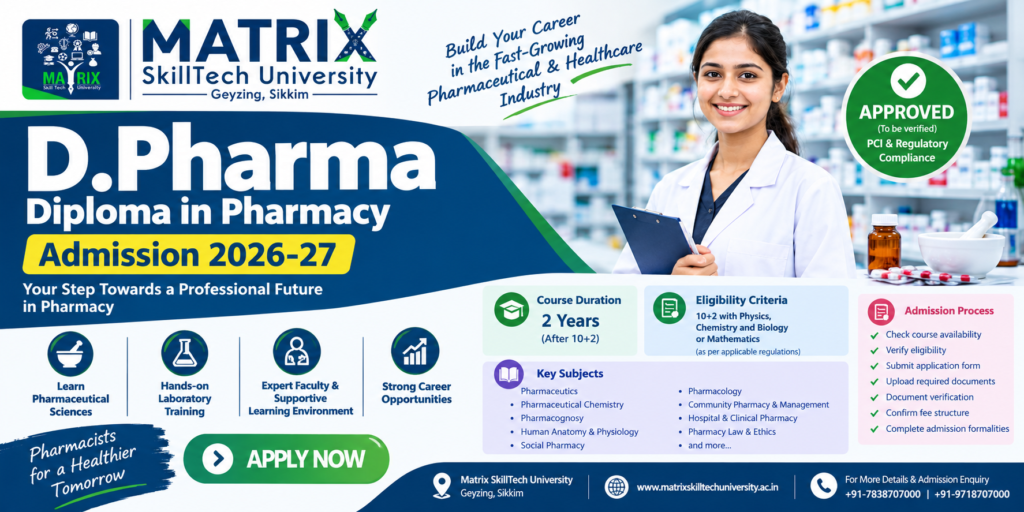
D.Pharma Admission 2026-27 at Matrix SkillTech University
-
Introduction to D.Pharma Course
D.Pharma Admission, also known as Diploma in Pharmacy is a diploma program designed for students who want to start a career in the pharmaceutical and healthcare industries. The course gives knowledge about medicines how they are made what they are used for the different ways they come how to keep them how to give them and how to handle them safely. It also teaches students about chemistry, pharmacology, pharmacognosy and pharmacy practice.
Students who have finished their Class 12 education with science subjects can think about D.Pharma as a way to get into the pharmacy field. The program has both classroom lessons and lab work and practical training so students can learn how medicines are made, managed, kept and given.
Students who want to do D.Pharma at Matrix SkillTech University should check if the university is currently offering the course, who’s in charge of the exams if it is connected to any university and if it has approval from the Pharmacy Council of India (PCI). The Pharmacy Council of India says that D.Pharma is a two-year course, after 10+2 and lists the pharmacy institutions that are allowed.
Students interested in pursuing D.Pharma at Matrix SkillTech University should confirm the institution’s current course availability, examining authority, affiliation, and applicable Pharmacy Council of India (PCI) approval before applying. PCI identifies D.Pharma as a two-year course after 10+2 and publishes information about approved pharmacy institutions.
-
What Is D.Pharma?
D.Pharma means Diploma in Pharmacy. D.Pharma is a pharmacy education programme that shows students the science and real‑world parts of medicines and pharmacy services.
The course helps students see how medicines work how they are kept how prescriptions are. How pharmacy products are managed safely. Students also learn about drug interactions, medicine safety, patient counselling and the importance of following a registered practitioner’s prescription. D.Pharma is a fit for students who want to look at jobs in community pharmacies, hospital pharmacies, pharmaceutical companies, medicine distribution and other health care services.. Finishing the diploma alone does not automatically let a person practise, as a registered pharmacist. Students must meet the required registration rules and pass any exit exams that are needed for their group.
D.Pharma Admission Course Highlights
|
Course Detail |
Information |
|
Full Course Name |
|
|
Popular Name |
D.Pharma / D.Pharm |
|
Course Level |
Diploma |
|
Academic Session |
2026-27 |
|
Course Duration |
2 academic years |
|
Eligibility |
10+2 with required science subjects |
|
Main Subjects |
Pharmaceutics, Pharmaceutical Chemistry, Pharmacology-related fundamentals, Pharmacy Practice |
|
Learning Method |
Classroom teaching, laboratory practicals and prescribed practical training |
|
Admission Mode |
As per the institution’s official admission policy |
|
Course Approval |
Must be verified for the specific institution and academic session |
|
Career Areas |
Retail pharmacy, hospital pharmacy, pharmaceutical industry and distribution |
|
Higher Studies |
B.Pharm, subject to applicable eligibility and admission rules |
-
D.Pharma Course Duration
The D.Pharma programme usually lasts two years after finishing Class 12. The curriculum covers theory, laboratory work, hands‑on learning and required practical training.
In the year students build a solid base in pharmaceutical sciences. Students learn about how medicinesre made different dosage forms, basic chemistry and the structure and function of the human body.
In the year students gain a deeper knowledge of pharmacy practice. Students explore pharmacology, pharmaceutical legislation, pharmacy and hospital pharmacy ideas and how to use medicines safely.
Practical training is a part of pharmacy education. Students must review the PCI rules and the official curriculum, from their school to know the practical training needs, assessment guidelines and exam dates.
-
D.Pharma Eligibility Criteria
Students planning to apply for D.Pharma should check the prescribed eligibility requirements before submitting an admission application.
The usual educational requirement is:
- The candidate must have passed Class 12 or an equivalent qualifying examination.
- The candidate should have studied Physics and Chemistry, along with Biology or Mathematics, as required by the applicable regulations.
- The qualifying examination must be from a recognized board or an accepted equivalent educational system.
- Candidates must satisfy the relevant age, documentation, and admission requirements applicable to the course and institution.
Students from non-science backgrounds should not assume that they qualify for admission. Applicants with open-school qualifications, vocational qualifications, or other non-standard educational backgrounds should seek written clarification from the institution and the relevant regulatory authority.
-
D.Pharma Admission Process 2026-27
Students interested in D.Pharma admission at Matrix SkillTech University can use the following general admission checklist. The actual process may differ depending on the university’s official policy and the applicable regulations.
Step 1: Check Course Availability
Confirm whether D.Pharma is offered for the 2026-27 academic session. Ask for the official programme name, campus address, approved intake, examining authority, and course approval documents.
Step 2: Verify Eligibility
Review your Class 12 marksheet and confirm that you have studied the required science subjects. Check the institution’s eligibility requirements before proceeding.
Step 3: Submit the Application
Complete the official application form using accurate personal, academic, and contact details. Submit it through the authorized admission channel.
Step 4: Upload Required Documents
Applicants may be asked to provide the following documents:
- Class 10 marksheet and certificate
- Class 12 marksheet and certificate
- Recent passport-size photographs
- Valid identity proof
- Transfer certificate or school-leaving certificate, where required
- Migration certificate, where applicable
- Category or reservation certificate, if applicable
- Other documents specified in the official admission notification
Step 5: Complete Document Verification
The institution checks the submitted educational records and eligibility details. Applicants should obtain confirmation that their documents have been accepted.
Step 6: Confirm the Fee Structure
Request an official fee schedule covering tuition, examination, laboratory, registration, practical training, and any other applicable charges. Ask for a written refund policy before paying.
Step 7: Confirm Admission
Complete the admission formalities only after verifying the institution’s applicable approvals, affiliation, eligibility requirements, and payment terms. Keep copies of the application, receipts, and admission confirmation.
- D.Pharma Syllabus and Subjects
The D.Pharma syllabus is designed to develop a student’s understanding of pharmaceutical sciences and the responsible use of medicines. The subjects below reflect the main areas covered under the PCI Education Regulations, 2020 framework; students should consult the institution’s approved syllabus for the exact subject names, sequence, and assessment pattern.
First-Year D.Pharma Subjects
- Pharmaceutics
Pharmaceutics introduces students to the formulation, preparation, packaging, and storage of medicines. Students learn about dosage forms such as tablets, capsules, syrups, ointments, creams, and solutions. The subject also explains pharmaceutical calculations, basic dispensing practices, and quality considerations.
- Pharmaceutical Chemistry
This subject introduces the chemical principles related to pharmaceutical substances. Students study the properties, identification, purity, and analysis of selected chemical compounds used in medicines. Laboratory practicals help them understand basic analytical procedures and laboratory safety.
- Pharmacognosy
Pharmacognosy focuses on drugs and medicinal substances obtained from natural sources, particularly plants. Students learn about crude drugs, medicinal plants, their identifying characteristics, active constituents, and traditional as well as modern pharmaceutical applications.
- Human Anatomy and Physiology
This subject explains the structure and functions of the human body. Students study major body systems, including the digestive, respiratory, cardiovascular, nervous, urinary, and endocrine systems. This knowledge provides a foundation for understanding how medicines affect the body.
- Social Pharmacy
Social Pharmacy introduces students to the relationship between medicines, public health, and society. Topics may include health awareness, disease prevention, sanitation, nutrition, vaccination awareness, and the pharmacist’s role in promoting responsible medicine use.
Second-Year D.Pharma Subjects
- Pharmacology
Pharmacology introduces the actions and effects of medicines on the human body. Students learn about drug classifications, therapeutic uses, side effects, precautions, and the importance of using medicines under appropriate professional guidance.
- Community Pharmacy and Management
This subject explains the functioning of community pharmacies and the principles of pharmacy management. Students learn about prescription handling, inventory control, storage conditions, customer communication, documentation, and responsible dispensing practices.
- Biochemistry and Clinical Pathology
Students study essential biochemical processes and the basic principles of clinical laboratory investigations. Topics can include carbohydrates, proteins, lipids, enzymes, body fluids, and the clinical significance of selected laboratory tests.
- Pharmacotherapeutics
Pharmacotherapeutics introduces the principles behind medicine use for different diseases. Students learn about treatment objectives, medication safety, adherence, adverse drug reactions, and the pharmacist’s role in supporting appropriate therapy.
- Hospital and Clinical Pharmacy
This subject covers pharmacy services in hospitals and clinical settings. It introduces students to hospital medicine supply systems, prescription review, medication records, drug information, patient counselling, and coordination with healthcare professionals.
- Pharmacy Law and Ethics
Students learn about the legal and ethical responsibilities associated with pharmacy practice. The subject introduces relevant pharmacy legislation, medicine regulation, prescription requirements, professional conduct, and the importance of complying with applicable laws.
Important: This is a general subject overview, not a substitute for the official syllabus. Always use the current approved curriculum when publishing detailed semester-wise or year-wise subject information.
- D.Pharma Practical Training
Practical learning helps students apply classroom knowledge to real-world pharmacy activities. The programme includes laboratory exercises and practical exposure according to the applicable curriculum.
Common learning activities may include:
- Preparing and evaluating basic pharmaceutical formulations.
- Identifying pharmaceutical ingredients and selected medicinal substances.
- Performing prescribed laboratory tests.
- Learning appropriate medicine storage and stock management.
- Understanding prescription processing and dispensing procedures.
- Maintaining laboratory records and pharmaceutical documentation.
- Learning about patient communication and medicine safety.
- Observing pharmacy operations in an authorized practical-training setting.
PCI’s regulatory framework prescribes practical-training and educational requirements for pharmacy courses. Students should obtain the official training schedule from the institution and confirm where their practical training will take place.
- D.Pharma Course Fees
The total cost of D.Pharma depends on the institution, campus, facilities, examining authority, and applicable fee rules. A verified official fee amount for Matrix SkillTech University’s D.Pharma programme has not been established here, so an unconfirmed figure should not be presented as the university’s actual fee.
Students should request a written fee structure covering the following items:
|
Fee Component |
What to Confirm |
|
Registration Fee |
One-time or annual payment |
|
Tuition Fee |
Total annual and programme cost |
|
Examination Fee |
Charges for examinations and assessments |
|
Laboratory Fee |
Practical and laboratory charges, if applicable |
|
Training Fee |
Whether practical training involves additional charges |
|
Other Charges |
Registration, university services or other approved costs |
|
Refund Policy |
Rules applicable if admission is cancelled |
Career Scope After D.Pharma
D.Pharma can provide a foundation for several career pathways in the healthcare and pharmaceutical sectors. The actual roles available to a graduate depend on their skills, employer requirements, applicable regulations, and professional registration status.
- Community or Retail Pharmacy
Graduates may explore work in retail pharmacy settings. Roles involving the professional dispensing of medicines require the relevant pharmacist registration and compliance with applicable laws.
- Hospital Pharmacy
Hospital pharmacies manage medicine storage, supply, documentation, and dispensing. Eligible candidates may explore suitable roles in hospital pharmacy departments, subject to registration and employer requirements.
- Pharmaceutical Industry
Pharmaceutical companies offer different kinds of entry-level opportunities, depending on qualifications and recruitment criteria. These may include selected production-support, packaging, documentation, or quality-related positions.
- Pharmaceutical Distribution
Graduates may explore opportunities with medicine wholesalers, distributors, stockists, and supply-chain businesses. The specific role and any licence requirements depend on the activity being performed.
- Medical Store Business
Some graduates may consider establishing a pharmacy business. However, opening and operating a medical store involves applicable drug licensing, premises, documentation, and registered-pharmacist requirements. A diploma by itself does not replace these legal requirements.
- Government and Private-Sector Recruitment
Pharmacist vacancies may be advertised by government hospitals, public-sector institutions, healthcare organizations, and private employers. Eligibility, registration, examinations, experience, and selection procedures vary by recruitment notice.
Students should not assume that a D.Pharma qualification guarantees a government job or immediate employment. Career progression depends on meeting the requirements of the particular position.
- Higher Education After D.Pharma
Students who wish to continue their education can explore further pharmacy qualifications.
Bachelor of Pharmacy (B.Pharm): Eligible D.Pharma graduates may explore admission to B.Pharm, including applicable lateral-entry routes where permitted. Admission depends on the relevant regulations and the institution’s eligibility requirements.
Further Professional Development: Graduates can also consider suitable training, skill-development programmes, and industry-specific learning to improve their knowledge of pharmacy operations and pharmaceutical services.
Before selecting a higher-education programme, check its recognition, eligibility criteria, mode of study, and professional outcomes.
- Why Choose D.Pharma?
D.Pharma may be a suitable option for students who want to enter the pharmacy field through a diploma-level qualification. Some of its key advantages include:
- Professional knowledge: Develop a foundation in pharmaceutical sciences and medicine safety.
- Practical learning: Gain experience through laboratory activities and prescribed practical training.
- Healthcare exposure: Understand how pharmacies support patients and healthcare professionals.
- Career flexibility: Explore opportunities in pharmacy services, pharmaceutical businesses, and related industries.
- Further education: Consider progressing to B.Pharm if eligible under the applicable admission rules.
- Industry understanding: Learn about pharmaceutical products, storage, documentation, and dispensing procedures.
Students should choose an institution based on the quality of teaching, laboratory facilities, practical-training arrangements, official approvals, and transparency of its admission process.
- Important Approval and Recognition Information
Before taking admission to D.Pharma at Matrix SkillTech University, students should verify the following documents:
- The official name and legal status of the institution offering the course.
- Current PCI approval for the specific institution and D.Pharma programme.
- Approval validity for the relevant academic session, including 2026-27.
- The approved intake and campus address.
- The examining authority or university affiliation applicable to the programme.
- Any applicable state government approval or other regulatory documents.
-
Frequently Asked Questions (FAQs)
Q1. What is the full form of D.Pharma?
D.Pharma stands for Diploma in Pharmacy. It is a professional diploma programme that introduces students to pharmaceutical sciences, medicines, dispensing, and pharmacy practice.
Q2. What is the duration of the D.Pharma course?
The D.Pharma course generally has a duration of two academic years after Class 12, along with the practical-training requirements prescribed under the applicable regulations.
Q3. What are the eligibility criteria for D.Pharma?
Students generally need to pass Class 12 with Physics and Chemistry, along with Biology or Mathematics, subject to the applicable educational regulations and institutional requirements.
Q4. Is D.Pharma available at Matrix SkillTech University?
Students should confirm current course availability directly with Matrix SkillTech University. They should also verify the institution’s applicable PCI approval, examining authority, and affiliation for the 2026-27 academic session before applying.
Q5. What is the fee for D.Pharma at Matrix SkillTech University?
The official fee has not been independently verified here. Students should obtain the latest written fee schedule from the institution, including tuition, examination, laboratory, registration, and other applicable charges.
Q6. Can I open a medical store after D.Pharma?
Eligible graduates may explore establishing a pharmacy business, but operating a medical store requires the applicable drug licence, compliance with legal requirements, and registered-pharmacist arrangements where prescribed. Completing D.Pharma alone does not automatically authorize the operation of a pharmacy.
Q7. Can I pursue B.Pharm after D.Pharma?
Yes, eligible D.Pharma graduates can explore B.Pharm admission. Lateral-entry eligibility and admission procedures depend on the applicable regulations and the institution’s approved admission policy.
Q8. What are the main subjects in D.Pharma?
The curriculum covers subjects such as Pharmaceutics, Pharmaceutical Chemistry, Pharmacognosy, Human Anatomy and Physiology, Social Pharmacy, Pharmacology, Pharmacotherapeutics, Hospital and Clinical Pharmacy, Community Pharmacy and Management, and Pharmacy Law and Ethics.
Q9. Can D.Pharma graduates apply for government jobs?
They may apply for relevant vacancies when they satisfy the recruitment notification’s educational, professional registration, examination, age, and other eligibility requirements. Employment is not guaranteed by the qualification alone.
Q10. Is PCI approval important for D.Pharma?
Yes. PCI approval and the applicable regulatory requirements are important for a D.Pharma programme intended to support pharmacist registration and professional practice. Students should verify the specific institution and academic session rather than relying only on promotional material.
- Conclusion
D.Pharma is an option for students who wish to develop foundational knowledge of pharmaceutical sciences and explore careers in the pharmacy and healthcare sectors. The two-year programme combines theoretical education with practical learning and introduces students to medicines, pharmaceutical formulations, pharmacy management, and professional responsibilities.
Students considering D.Pharma at Matrix SkillTech University for the 2026-27 session should carefully review eligibility, fees, course availability, curriculum, practical-training facilities, and future career options. Most importantly, they should verify the programme’s current regulatory approval and examining authority before paying admission fees.
